Our Mission
Enhance the quality of life in our community
by protecting and improving Montgomery County's
air, water, and land in a sustainable, innovative,
inclusive, and industry-leading way while
fostering smart growth, a thriving more sustainable economy and healthy communities.

Our Director
 Jennifer Macedonia serves as the Director of the Montgomery County Department of Environmental Protection (DEP), where she leads efforts to implement the County's Climate Action Plan, promote our Zero Waste goals and sustainability initiatives, and enhance environmental resilience throughout the County.
Jennifer is a mechanical engineer with over 30 years of experience in environmental policy, climate strategy, and leadership in the clean energy sector. Prior to her appointment at DEP, she held senior roles at the U.S. Environmental Protection Agency (EPA), most recently as Deputy Assistant Administrator for Implementation in the Office of Air and Radiation. There, she led the rollout of over $10 billion in Inflation Reduction Act investments and helped design 15 new federal programs to reduce emissions and improve air quality.
Jennifer holds a B.S. in Mechanical Engineering from Villanova University and serves on the board of Project Green Schools. A long-time resident of Montgomery County, Jennifer looks forward to working with County departments, community partners, businesses and residents to build a more sustainable and resilient future for all.
Divisions
Office of the Director
Director
- Leads initiatives towards zero waste
- Leads initiatives towards reducing greenhouse gases
- Leads initiatives towards clean water
- External and internal communication regarding DEP accomplishments, people, and initiatives
- Develops strategic initiatives and partnerships leading to improved business opportunities and lower operating costs for DEP
Deputy Director
- Responsible for overall management of daily operations and Division leadership
- Support development and implementation of Department policies and strategic direction.
- Ensures positive organizational culture and workplace environment
- Safe operations and strong safety culture
Energy, Climate and Compliance Division
- Manage programs for Compliance with the County’s environmental laws
- Manage process to assist building owners with compliance with Energy Benchmarking law
- Provide leadership for County’s actions leading towards zero greenhouse gas emissions
- Manages residential energy programs to assist county residents with energy efficiency
Recycling and Resource Management Division
- Manages the County’s operations for collection and processing of recyclable materials for all single-family homes
- Manages the Transfer Station which receives municipal solid waste from around the county
- Manages the Resource Recovery Facility which provides for disposal of the county’s municipal solid waste
- Manages composting operations and production of LeafGro
- Manages initiatives to improve recycling in the county
Strategic and Administrative Services Division
- Fiscal Management
- Procurement
- Billing Management
- IT Operations and Infrastructure Management
- Performance and Data Management
- Administrative Operations
Watershed Restoration Division
- Monitors water quality and assesses condition of streams
- Inspects an maintains stormwater facilities
- Coordination of the County’s Municipal Separate Storm Sewer Systems (MS4) Permit
- Manages Capital Projects program for stormwater management
- Manages RainScapes program
- Manages Tree Montgomery program
- Manages Organic Lawn Care program
- Manages Pet Waste, Litter Reduction, and Community Grant programs
Zero Waste Programs Division
- Implement the County's "Aiming for Zero Waste" initiative to reduce waste and increase recycling.
- Enhance solid waste resource management and recovery efficiency across the County.
- Provide outreach, education, and enforcement of recycling policies through the Waste Reduction and Recycling Section.
- Develop and implement waste reduction, reuse, and recycling initiatives, including food waste recovery.
- Support the planning and development of future Solid Waste Plans.
Learn About Us
DEP 2025 Year in Review
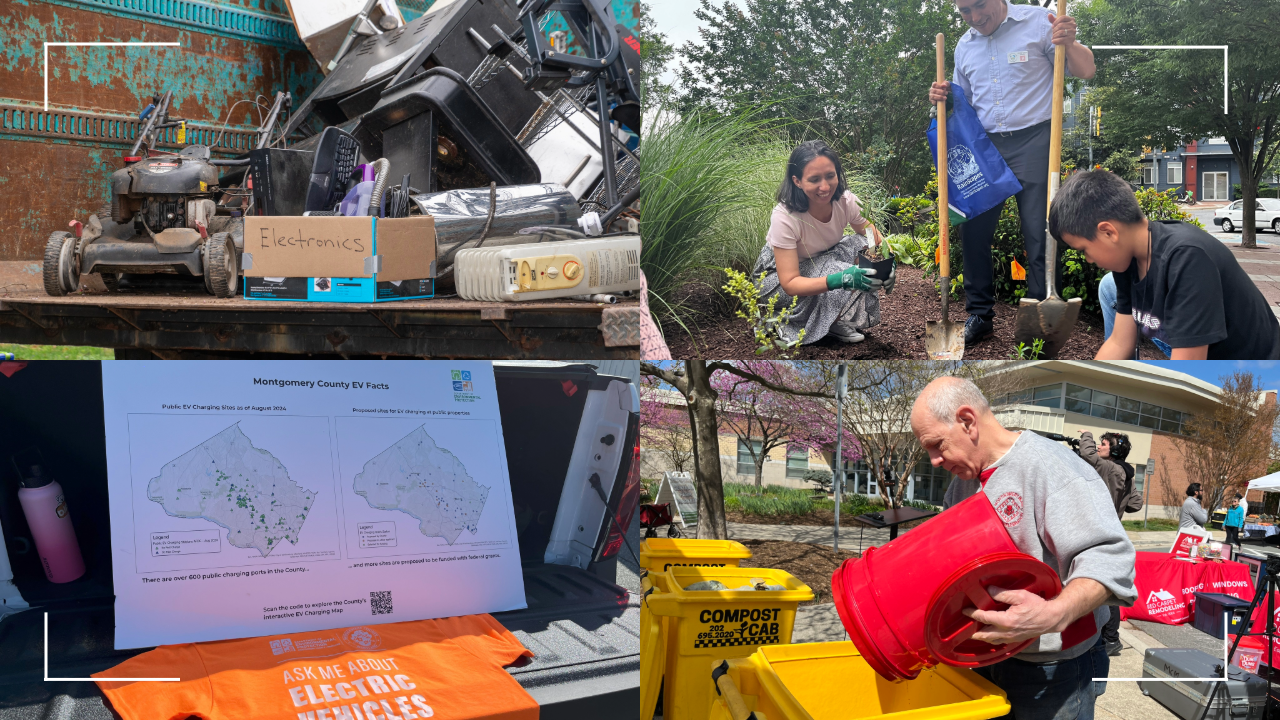 Watch the DEP 2025 Year in Review Video on Youtube
 Thank you to the Montgomery County Public School Student Climate Action Council for lending your voices to the 2025 DEP Year in Review video! Your commitment to climate action and environmental advocacy continues to inspire and energize our work.
Montgomery County's Department of Environmental Protection (DEP) 2025 Year in Review showcases a year of dedication, progress, and environmental stewardship. It highlights the department's initiatives, achievements, and community engagement throughout the past year.
Whether it's managing the County's trash and recycling, transitioning homes and businesses to cleaner energy, or protecting our waterways — DEP remains committed to enhancing the quality of life in our community by safeguarding our air, water, and land.
Check out DEP's 2025 highlights below or watch the full 2025 DEP Year in Review on YouTube.
Renewable Energy Milestones
We're making significant progress toward our major climate goals by reducing greenhouse gas emissions by 80% by 2027 and achieving net-zero by 2035. At the same time, we're preparing for our changing climate. One way we're doing this is by helping people switch to electric, whether at home or on the road.
- Awarded $1.2 million to local nonprofits helping income-eligible residents make their homes healthier, more energy-efficient, and climate-resilient.
- 231 households went solar through the Switch Together program, using group buying power to lower installation costs and switch to clean energy.
- DEP secured $4 million to expand public EV charging across the County.
- Launched a pilot for food trucks to replace noisy, polluting gas generators with cleaner, quieter electric alternatives—bringing cleaner air to busy community spaces.
Waste Reduction and Recycling Success
In 2025, DEP completed the phase-in of curbside recycling of electronics and batteries. Over 223,000 single-family households with county-provided recycling collection services can schedule the collection of electronics and batteries to help reduce the risk of fires in collection vehicles and our facilities. This will improve our recycling rates and help stop battery-related fires.
- Over 13,000 residents composted more than 45 tons of food scraps through food scrap drop-offs at local farmers markets, making composting easy for residents.
- 3.5 million pounds of food scraps were recycled through DEP's Commercial Food Scraps Recycling Partnership with businesses and organizations.
- DEP reached 28,000+ people at 374 events, teaching waste reduction, reuse, and recycling.
Protecting and Preserving the Watershed
In 2025, we celebrated 10 years of our Tree Montgomery program, having planted over 18,000 trees in the County – cleaning air, cooling neighborhoods, reducing stormwater, and saving $12M in future energy costs. Our work continues through programs aimed to clean streams and make our County a better place to live, work and play.
- Installed rain gardens with residents, schools, congregations, HOAs, and Habitat for Humanity to absorb stormwater and protect local streams.
- Awarded $350K in rebates to help residents and landscapers switch to quieter, cleaner electric leaf blowers.
- Distributed nearly $750K in grants to nonprofits for clean water projects and public education on stream health.
- Monitored 7 dams and 35 flood sensors, working with County agencies to map flood-prone areas and provide early warnings.
Our Values
The Department of Environmental Protection's core values drive our mission:
- Accountability: We take responsibility for our decisions and actions and the quality of our work at DEP. We admit to mistakes, correct them, learn from them, and carry on. We ensure taxpayer dollars are spent wisely to protect the environment.
- Commitment: We strive for success and we follow through on our actions as promised. We care about our workforce, our community, and the environment and we use the best science and other knowledge as we work to improve the environment. We work to improve the quality of our services and we work together across DEP divisions to get the job done.
- Customer Service: We serve the people who live, work, and play in Montgomery County. We listen to our customers (including our co-workers), and we make a positive difference in their lives by providing accurate, timely help in a friendly manner. We communicate clearly on the services offered and assist the public with all the tools we have available to the best of our abilities.
- Diversity, Equity and Inclusion: Just as we value the diversity of the species around us, we commit to giving voice to the diversity of our human experiences. We create a welcoming environment where everyone is valued, respected, heard and matters. We pledge to celebrate the plurality of languages, nationalities, races, religions, sexualities, genders, and (dis)abilities in our community, and engage historically underrepresented members in the creation and enforcement of policies and programs to provide equitable protection to clean land, air, and water, and habitable climate under the law.
- Integrity: We are honest, fair, humble, and we uphold the highest ethical standards in all actions. We are trustworthy and we hold true to our ethical principles and stand up for what is in the best interest of the community, even (especially) when it is the difficult thing to do. We don't play favorites, we do our work, and we provide factual guidance.
- Leadership and Action: We are at the forefront of shaping a better future. We advance DEP’s mission and take action based on passion, respect, responsibility and commitment to working with, and for the community. We set goals and follow through to completion, creating positive outcomes for the environment and showing results through our work. We lead by example and we inspire others to do good for our communities.
Racial Equity Vision Statement
DEP's Racial Equity Vision Statement is to apply a racial equity lens when setting policies, projects, and programs related to DEP's Mission, ensuring the inclusion of diverse groups, especially frontline/underrepresented communities:
- Racial equity lens: A racial equity lens is the set of questions we ask ourselves throughout the decision-making process. The lens interrupts the impact of unintended consequences by taking into consideration the lived experiences and perspectives of the racially diverse communities we intend to serve.
- Frontline/Underrepresented Groups: Describes a group of people whose members are disadvantaged and subjected to unequal treatment by the dominant group, and who may regard themselves as recipients of collective discrimination.
Organizational Chart
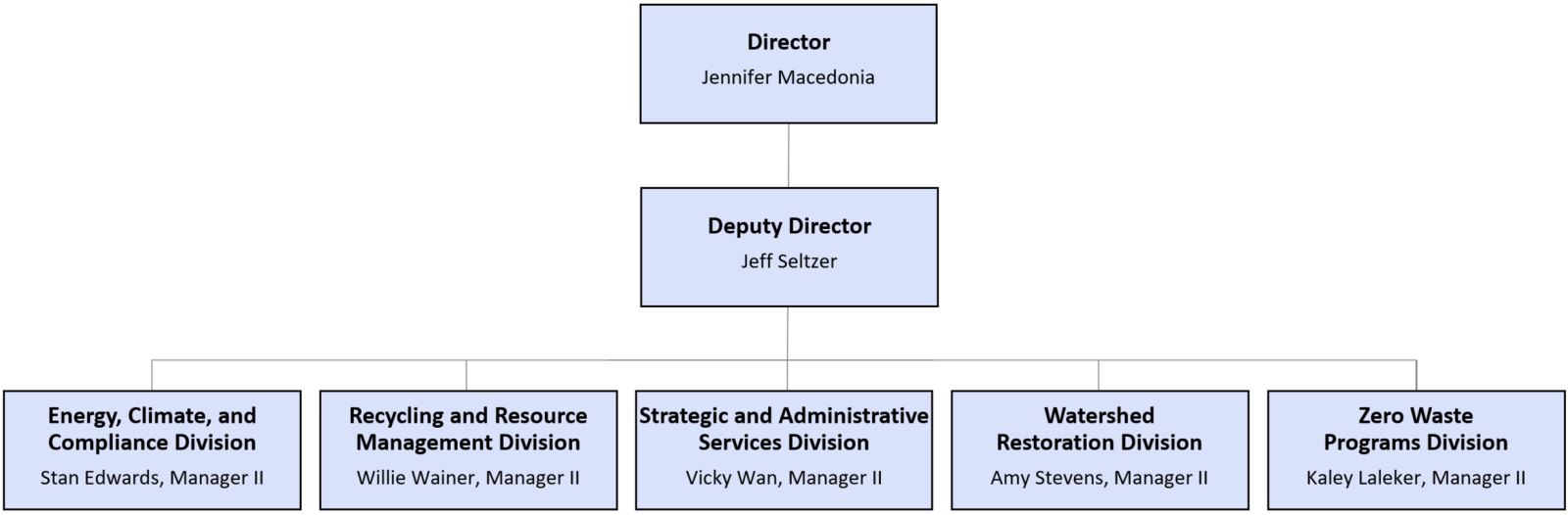
Director: Jennifer Macedonia
Deputy Director: Jeff Seltzer
The following divisions are overseen by the Deputy Director:
- Energy, Climate, and Compliance Division: Stan Edwards, Manager II
- Recycling and Resource Management Division: Willie Wainer, Manager II
- Strategic and Administrative Services Division: Vicky Wan, Manager II
- Watershed Restoration Division: Amy Stevens, Manager II
- Zero Waste Programs Division: Kaley Laleker, Manager II
Performance and Results
DEP's Performance Plan lists each of DEP's Headline Performance Measures and identifies how well the Department is achieving results through succinct analysis highlighting contributing factors, limiting factors, and ways DEP aims to improve its performance. It also outlines the Department's operational efficiency.
-
Amount of Pollutant Removed Through the Watershed Restoration Program
-
Average Number of Days to Resolve Incoming Environmental Complaints
-
Percent Satisfied with DEP's Response to Environmental Complaints
-
Average Visits to DEP Websites
-
Total Solid Waste Generated in the County
-
Tons of Total Municipal Solid Waste Recycled
-
Missed Collection (Refuse and Recycling) Complaints per Week
-
Percent of Businesses in Compliance with Recycling Reporting
-
Single-Family Solid Waste Charges
-
Percent of Commercial Buildings in Compliance with Benchmark Laws